
Remco Campert
auteur
Remco Wouter Campert was een veelzijdige Nederlandse dichter, romanschrijver, columnist en kinderboekenschrijver. Als prominent lid van de literaire beweging 'Vijftigers' debuteerde hij in 1950 met de bundel 'Het leven is vurrukkulluk'. Zijn werk kenmerkt zich door toegankelijkheid, waarbij hij vaak autobiografische elementen mengt met ironie en cynisme. Hij was breed populair om zijn proza, dat diverse genres besloeg van kinderliteratuur tot satirische romans. Campert ontving talloze onderscheidingen, waaronder de P.C. Hooft Prize in 1976 en de Prijs der Nederlandse Letteren in 2015.[1,2]
Remco Campert: Poetry, Prose, and Collaboration
A sourced account of Dutch poet and novelist Remco Campert (1929–2022), his role in the postwar Vijftigers movement, and his photobook collaboration with Joan van der Keuken on Achter glas (1957/1961).
The identity of Remco Campert is securely established by the ISNI authority record: Remco Wouter Campert (1929–2022), an author whose authorised forms include “Campert, Remco Wouter” and whose record links the pseudonyms Erce and Moreno. The Digital Library for Dutch Literature (DBNL), an independent scholarly digital library, gives his birth as 28 July 1929 in The Hague—as the son of the poet and resistance writer Jan Campert (1902–1943) and the actress Joekie Broedelet—and his death as 4 July 2022 in Amsterdam (Prijs der Nederlandse Letteren biography).
Campert came into view in immediate postwar Dutch literary culture after leaving the Amsterdams Lyceum, where he had drawn comic strips and written for the school paper while spending his days in cinemas and jazz clubs (Prijs der Nederlandse Letteren). Together with his school friend Rudy Kousbroek, he founded the experimental magazine Braak, whose first issue appeared in May 1950. The National Library of the Netherlands (KB) overview identifies him as one of the Vijftigers (alongside Lucebert, Gerrit Kouwenaar, and Simon Vinkenoog), a postwar generation that rejected inherited literary conventions in favour of experiment. Within that movement Campert was regarded as the most accessible voice: his poetry developed associatively, shaped by modern jazz (his 1950 self-published debut chapbook of 25 copies, Ten lessons with Timothy, took its title from a Dizzy Gillespie recording), and combined everyday realism with understated irony (KB; Prijs der Nederlandse Letteren).
The breadth of his literary output is documented in the DBNL author bibliography, which records his official poetry debut Vogels vliegen toch (1951), Een standbeeld opwinden (1952), Berchtesgaden (1953), and the Vijftigers anthology Vijf 5tigers (1954), followed by his celebrated novel Het leven is vurrukkulluk (first edition 1961), Liefdes schijnbewegingen (1963), and Het gangstermeisje (1965). After a period of writer’s block in the 1970s, Campert returned to sustained publication in 1979, writing the 1985 Boekenweekgeschenk Somberman’s actie, performing on stage with Jan Mulder from 1989 to 1995, and co-writing their daily front-page de Volkskrant column “CaMu” from 1996 (Prijs der Nederlandse Letteren).
Photobook and periodical collaborations: Achter glas and Bijster
Campert’s work repeatedly intersected with Dutch photography and visual culture. Most notably, he wrote the text for photographer and filmmaker Joan van der Keuken’s second photobook, Achter glas (first published in Hilversum by C. de Boer Jr. in 1957, with a subsequent edition in 1961) (Josef Chladek). Conceived as a "photo-novel" (beeldroman), the 96-page volume pairs Van der Keuken’s black-and-white photographs of two adolescent sisters, Georgette and Yvonne, daydreaming behind windowpanes and lingering in rooms on the threshold of adulthood, with Campert’s spare, unsentimental prose (Josef Chladek). Earlier in the decade, Campert’s poetry had also been paired with photography and graphic design in volumes such as Waren wij maar zeventien (1958), and in 1969 he contributed to the periodical issues of Bijster (nos. 1–6). These collaborations situate Achter glas within a career that moved fluidly across poetry, short fiction, journalism, translation, and visual books.
Campert received the major distinctions of Dutch letters: the National Library of the Netherlands records the P.C. Hooft Prize for poetry (1979) and the Gouden Ganzenveer (2011), while the Prijs der Nederlandse Letteren honours him as its 2015 laureate.
Sources
Boeken
-
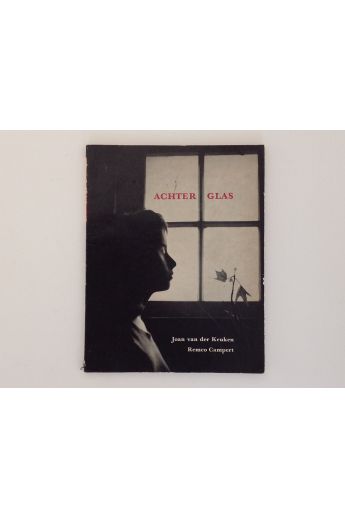 Achter Glas€ 110,00
-
 Bijster no 3 - 1969€ 30,00
-
 Bijster no 4 - 1969€ 30,00


Werk van Remco Campert
- 1950 Het leven is vurrukkulluk Poetry collection.
- 1960 Tjeempie! of Liesje in luiletterland Satirical novel.
Prijzen
- 1976 P.C. Hooft-prijs
- 2015 Prijs der Nederlandse Letteren