
Carel Blazer
fotograaf
Carel Blazer was een Nederlandse fotograaf wiens werk de brug sloeg tussen de periode van New Photography en de sociale reportage uit het midden van de 20e eeuw. Hij wordt vooral herinnerd om zijn documentatie van de Spanish Civil War en zijn uitgebreide werk in de sociale fotografie tijdens de jaren 1940 en 1950. Blazer werd opgeleid in Zwitserland en was een sleutelfiguur in Nederlandse fotografische kringen, waarbij hij bijdroeg aan zowel artistieke als journalistieke fotografie.[1]
- sociale fotografie
- Spanish Civil War
- New Photography
- documentaire fotografie
Carel Blazer: Photography in the Service of People, Work, and Water
Carel Blazer (1911–1980) joined technical rigor to social commitment, moving from antifascist reportage and resistance work to a central role in postwar Dutch applied photography. His books, Delta Works images, GKf collaborations, colour experiments and monumental enlargements reveal a photographer who treated print and public space as photography’s most consequential forms.
Carel Adriaan Blazer (Amsterdam, 16 June 1911–Nijmegen, 16 January 1980) belongs to the generation that gave Dutch documentary photography a modern social purpose before the Second World War and an influential applied form after it. The identification is secure: the RKD authority record gives those dates and places, lists his working years as 1933–1974, and records both his full name and the short-lived 1945 pseudonym “Carel Corza” (RKDartists). His career is unusually legible through books: reportages, industrial commemorative volumes, exhibition catalogues and his late retrospective Anderland together show how he treated the printed page—not the gallery wall alone—as photography’s natural public setting.
From New Objectivity to social reportage
Blazer first studied mechanical engineering, an education that helps explain his lifelong command of cameras, darkrooms and large-scale printing. In 1934–35 he studied in Zürich with Hans Finsler, whose exacting New Objectivity emphasized clear description, tonal control and respect for the object being photographed. Back in Amsterdam, Blazer shared premises at Keizersgracht 522 with Eva Besnyö and architect Alexander Bodon. He made portraits and commercial work, but his involvement with the Vereeniging van Arbeiders-Fotografen and antifascist cultural organizations soon drew him toward reportage (Tineke de Ruiter, Depth of Field/Leiden University).
That commitment made him one of the organizers of the international foto ’37 exhibition at the Stedelijk Museum Amsterdam. In the same year he spent three months in Republican Spain with journalist Maarten “Mik” van Gilse. He photographed children’s homes in Valencia, the International Brigades and life behind the front; unlike Robert Capa’s battle imagery, Blazer’s published photographs generally withheld the instant of violence and concentrated on people living within war. The International Institute of Social History’s biographical project confirms his full identity, his March–May 1937 Spanish journey and the display of this work at foto ’37 (IISG, “Blazer, Carel”). This was not neutrality: it was an engaged photographer’s preference for human conduct over spectacle.
Occupation, resistance and liberation
During the German occupation, Blazer’s political convictions became direct resistance work. He helped the Persoons Bewijs Centrale falsify identity documents. Arrested in April 1943 with Ad Windig and Kryn Taconis, he was sentenced to death on an espionage charge, but the case was redirected toward a man safely outside occupied territory; Blazer was released on 10 February 1944. His sister and brother-in-law, arrested in the same action, were deported to Birkenau and did not return (De Ruiter, Leiden University). He was associated with the photographers’ resistance network later known as De Ondergedoken Camera, yet after prison he judged direct aid more useful than clandestine street photography. At liberation he again worked openly, photographing Amsterdam in May 1945 and war damage across the Netherlands (IISG).
Applied photography and the GKf
In 1945 Blazer co-founded the Gebonden Kunstenaars federatie (GKf). The group understood photography as a “bound” or applied art: an image served an assignment, a publication, an exhibition or an architectural space, often in close partnership with a graphic designer. Blazer worked with figures including Jan Bons, Benno Wissing and Gerard Wernars and became the GKf photographers’ technical authority and moral elder. His mastery was practical as well as aesthetic: he printed for other photographers, built darkroom devices and produced monumental enlargements. For the Dutch pavilion at Expo ’58, a 1956 aerial photograph by Luc Vrind and Blazer of the closing of the Eastern Flevoland ring dike was divided into 250 sections and enlarged into a 580-square-metre dome image—an extreme example of photography becoming architecture (De Ruiter). The GKf recognized his contribution with its prize in 1968.
This applied ideal explains the importance of Blazer’s company books. Publications such as 50 Jaar Bruynzeel 1897–1947, The Finishing Touch: 100 Jaar Twentsche Stoombleekerij (1957), 4 Gaten in de grond (c. 1961) and Wegen naar morgen (1962) were not peripheral jobs but central expressions of postwar Dutch photobook culture. Even on commission, he often shifted attention from a product to the people who used or made it: a bearing factory, for example, might be represented through cyclists rather than isolated bearings. Leiden’s scholarly monograph describes this human-centered strategy and documents his repeated collaboration with GKf designers (De Ruiter). MoMA’s collection preserves another trace of that alliance between image and graphic form: Pieter Brattinga’s 1960 photolithographic poster Fotografie Carel Blazer, printed by Steendrukkerij de Jong (Museum of Modern Art).
Water, reconstruction and a humanist eye
Water is the great recurring subject of Blazer’s postwar work. He photographed the inundation of Walcheren in 1945, the reclamation of flooded land and, from the 1950s, the Delta Works. His mechanical intelligence met a national story of reconstruction, but his pictures did not reduce the landscape to engineering diagrams: workers and machines appear as participants in an elemental struggle. The Rijksmuseum holds his 1960 calendar containing seven photomechanical prints of the Delta Works in Zeeland, South Holland and North Brabant, evidence of how this sustained project circulated as designed print rather than only as autonomous photographs (Rijksmuseum).
Blazer carried the same attention to ordinary activity into travel reportage in Italy, Portugal, Sicily, Asia and Latin America. Fishing communities, harbours, ships and lighthouses repeatedly brought him back to water. His postwar outlook was consciously humanist and pacifist: people at work, eating, resting or celebrating mattered more than scenes calculated to shock. Formally, he often used a high viewpoint and a horizon pushed to—or beyond—the upper edge, producing deep fields in which collective activity could unfold. He also embraced colour early, leaving roughly three thousand colour transparencies and using colour for celebrated Van Ommeren calendars (De Ruiter).
Books and legacy
Blazer stopped photographing after a hip fracture in 1974. His summative book, Carel Blazer fotograaf: Anderland, with an introduction by Willem Frederik Hermans, appeared in December 1979 alongside an exhibition at the Gemeentemuseum in The Hague; he died the following month. The book’s position at the end of his life is significant, but no single retrospective volume can contain a practice deliberately dispersed across magazines, calendars, company histories, exhibition walls and collaborative books. His institutional afterlife is correspondingly broad: the Stedelijk Museum holds numerous prints and publication-related works (Stedelijk Museum Amsterdam), while MoMA records his participation in Postwar European Photography in 1953 and The Photographic Poster in 1964 (MoMA artist record).
Blazer’s lasting importance rests less on a signature image than on a coherent ethic. Technical precision, political responsibility and collaboration were inseparable. He brought the clarity of New Objectivity into social reportage, survived the point at which photography and resistance became matters of life and death, and then helped make the postwar Dutch photobook and photographic wall into serious public forms. The many industrial and commemorative books bearing his photographs should therefore be read not as secondary commercial production, but as the principal arena in which he tested what a socially useful photograph could do.
Selected sources
- RKDartists authority record: Carel Blazer
- Tineke de Ruiter, “Carel Blazer,” Geschiedenis van de Nederlandse fotografie, Leiden University
- International Institute of Social History, “Blazer, Carel”
- Rijksmuseum, Kalender voor het jaar 1960 met foto’s van de Deltawerken
- Museum of Modern Art, Carel Blazer artist record
- Stedelijk Museum Amsterdam, Carel Blazer collection record
Boeken
-
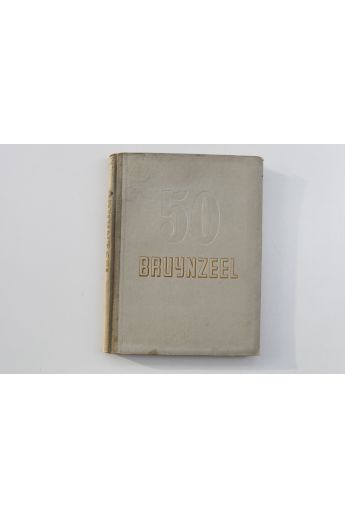 50 Jaar Bruynzeel 1897 - 1947€ 45,00
 -
 Boekenbalboekje€ 10,00


Werk van Carel Blazer
- 1940 Waar Nederland trotsch op is Visual contributor.
Referenties
- Carel Blazer. Waar Nederland trotsch op is. A.W. Sijthoff's. 1940