
Sophie Calle
auteur · fotograaf
Sophie Calle is een Franse schrijfster, fotograaf, installatiekunstenaar en conceptuele kunstenaar. Ze werd in 1953 geboren in Parijs en maakte haar opkomst op de kunstscene eind jaren '70, waarbij ze onder meer deelnam aan de Paris Biennale van 1979 met haar werk 'Les Dormeurs'. Haar artistieke praktijk kenmerkt zich door het opbouwen van archieven rondom 'echte verhalen', waarbij vaak sprake is van het volgen van vreemden, persoonlijke onderzoeken en rituelen. Ze combineert regelmatig tekst en fotografie om thema's als intimiteit, surveillance en de grenzen tussen publiek en privaat leven te verkennen. Een opmerkelijk voorbeeld van haar methodologie is 'L'Hôtel' (1984), waarin ze drie weken lang als kamermaagd in Venetië werkte om de sporen die door hotelgasten achterbleven te documenteren.[1,2,3,4,5,6]
- voyeurisme
- intimiteit
- surveillance
- archieven
- identiteit
Sophie Calle: Rules, Evidence, and the Intimacy of Strangers
A sourced study of Sophie Calle’s rule-based investigations of intimacy, surveillance, absence, and autobiography across photography, text, installation, and artist’s books.
Sophie Calle’s work turns self-imposed procedures into accounts of intimacy, surveillance, absence, and interpretation. Photography is central to these projects, but it is regularly joined by text, installation, video, and books. The Library of Congress authority record gives the authorized form “Calle, Sophie” and her birth date as 9 October 1953; the Bibliothèque nationale de France (BnF) identifies her as a French author associated with photography, and Centre Pompidou identifies her as a French photographer born in Paris in 1953. (Library of Congress; BnF authority record; Centre Pompidou)
Rules and records
According to the Guggenheim, Calle left formal education after secondary school, spent seven years traveling in China, the United States, and Mexico, and did not attend art school. She began to follow strangers after returning to Paris in the late 1970s, hoping to reacquaint herself with the city; she had taken up photography while living in California and was influenced by Duane Michals’s combinations of image and caption. (Guggenheim Museum)
Calle’s procedures give a rule or role to an encounter and then turn its traces into a narrative. De Pont Museum describes her work as moving between a wish to gain a hold on existence and a wish to surrender to it; it also notes that her private life functions as an instrument in her method rather than simply as its subject. (De Pont Museum)
In The Sleepers (1979), Calle invited people to sleep in her bed in eight-hour shifts and documented their stays with notes and photographs. The Guggenheim describes the installation’s contrast between intimate images and cool, anthropological textual descriptions. Centre Pompidou places Les Dormeurs at the 1979 Paris Biennale, an early public appearance of the method. (Guggenheim Museum; Centre Pompidou, L’Hôtel analysis)
For Suite vénitienne (1980), Calle followed one of her Parisian subjects to Venice for thirteen days. The resulting book includes an afterword by Jean Baudrillard; the Guggenheim’s account notes his attention to the violence, seduction, and loneliness of the act of following. (Guggenheim Museum)
The Address Book (1983) extended this indirect portraiture. Calle used a found address book to contact its owner’s acquaintances and construct a portrait through their descriptions. De Pont records that her findings appeared as 28 daily installments in Libération. The project makes the mediated character of testimony its subject: the person emerges only through other people’s accounts. (De Pont Museum, Talking to Strangers)
L’Hôtel: evidence and trespass
L’Hôtel (1981–83) brings together role-playing, photographs, and written reports. Calle worked as a chambermaid in a Venetian hotel for three weeks and investigated the traces that guests left behind. Centre Pompidou’s collection record describes the acquired work as seven photographic diptychs and a text, with color images of rooms, black-and-white photographs, and her written reports. (Centre Pompidou, L’Hôtel)
Centre Pompidou characterizes Calle’s practice as archives built around “true stories,” including the shadowing of strangers, games, rituals, absences, and disappearances. Its account of L’Hôtel makes the work’s central tension explicit: the materials create a revelation while also demonstrating the impossibility of truly grasping another person. (Centre Pompidou, L’Hôtel)
This is also where the ethical pressure of Calle’s projects becomes most apparent. De Pont observes that her scenarios can balance on the boundary of what is acceptable in relation to other people’s privacy. The viewer encounters not neutral documentation but evidence produced through an intentionally intrusive procedure. (De Pont Museum)
Autobiography distributed among others
Calle often turns personal experience into a collective form. BnF describes the subject in her work as fragmented and mobile: she tells her story while asking others either to testify to analogous experiences or to interpret a secret she has disclosed. The result moves what began as intimate material toward a collective, public form. (BnF bibliography)
Take Care of Yourself (2007) is a defining example. After a former lover ended their relationship by email, Calle asked 107 women to analyze, comment on, or sometimes answer it from their respective professional perspectives. De Pont lists participants including a mediator, linguist, psychiatrist, police officer, novelist, singer, dancer, and clown, and describes an installation made from texts, photographs, and video. The work was shown at the 2007 Venice Biennale and later formed the centerpiece of De Pont’s 2010 exhibition Talking to Strangers. (De Pont Museum, Talking to Strangers)
Institutional retrospectives reflect the scale of a practice that began with small, precise rules. Centre Pompidou presented M’as-tu vue? from 19 November 2003 to 15 March 2004, and the Guggenheim records a 2009 retrospective at Whitechapel Gallery. Centre Pompidou’s holdings include L’Hôtel, Gotham Handbook, Les Autobiographies, and Douleur exquise, demonstrating the range of forms in which she has worked. (Centre Pompidou; Guggenheim Museum)
Publications linked to this profile
The linked publication records represent distinct moments in Calle’s practice. L’Hôtel. Écrit sur l’image is linked as a 1984 French publication. Centre Pompidou identifies the underlying project as L’Hôtel (1981–83), a photographic installation in which text and photography articulate the chambermaid investigation. (Centre Pompidou, L’Hôtel)
Het adresboekje is linked as a 1994 Dutch publication. Its publisher’s page credits Sophie Calle and translator Jan de Heer and specifies 66 pages of text and black-and-white photographs, ISBN 9789071346194. (Uitgeverij 1001)
Aveugles is linked as a 2011 publication. Delpire & Co. records the Actes Sud edition as dated 1 December 2011, with 166 pages and ISBN 9782330000493; its description says that testimonies from blind people are placed in dialogue with photographs made from those accounts. (Delpire & Co.)
These books should not be treated as interchangeable containers for the same work. Their differing languages, sequences, and publication contexts are part of how Calle’s procedures move between text, image, testimony, and narrative.
Sources
- Library of Congress Name Authority File
- Bibliothèque nationale de France authority record
- Bibliothèque nationale de France bibliography
- Centre Pompidou, Sophie Calle
- Centre Pompidou, L’Hôtel
- Solomon R. Guggenheim Museum, Sophie Calle
- De Pont Museum, Sophie Calle collection profile
- De Pont Museum, Talking to Strangers
- Uitgeverij 1001, Het adresboekje
- Delpire & Co., Aveugles
Boeken
-
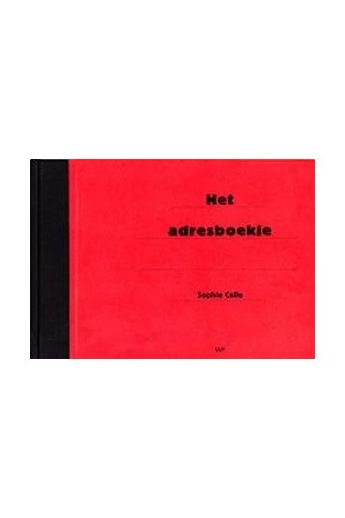 Het adresboekje druk 1€ 50,00
 -
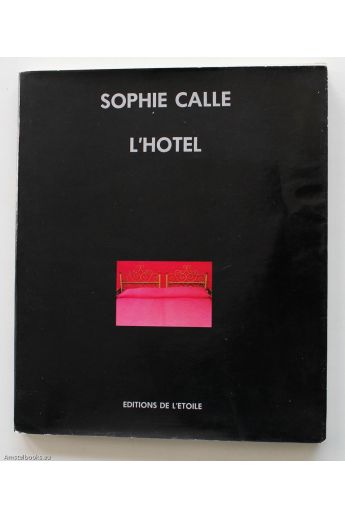 L'hotel. Ecrit sur l'image€ 360,00
 -
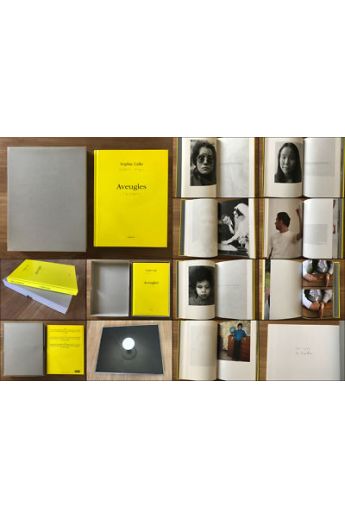 SOPHIE CALLE - AVEUGLES€ 69,00


Werk van Sophie Calle
- 1984 L'Hôtel Artist's book based on her 1981 experience as a chambermaid in Venice.
- 1979 Les Dormeurs First major work presented at the Paris Biennale.
- 1980 Suite vénitienne Inaugurated her method of creating situations and rituals.
- 1995 Les Autobiographies Part of her series of autobiographical works.
- 1994 Gotham Handbook Conceptual work.
Tentoonstellingen
- 2000 Sophie Calle